

NFDIxCS Stakeholder
The development of stakeholders within the NFDIxCS community has been guided by a strategic vision. This initiative began with direct communication with representatives from anticipated stakeholder groups. The short-term goal was to understand their diverse needs; in the long term, the focus was on identifying, categorizing, and prioritizing these stakeholders. To structure this process, three guiding dimensions were defined: i. Who are the project stakeholders?, ii. What motivates these stakeholders? and iii. What priorities do they have?
Stakeholders Groups
A dedicated workshop held in September 2023 served as the starting point for stakeholder identification and needs assessment. Participants were divided into four focus groups: Academic Staff, Advisory Boards, Scientific Projects and NFDI Services.
Each group addressed a key question intended to compile a comprehensive list of individuals, organizations, and institutions with a vested interest in or influence on the project. The table below summarizes the groups, their target stakeholders, and the discussion prompts:
| Stakeholder Group | Target groups | Discussion question |
|---|---|---|
Academic Staff | Researchers | Which persons of the academic staff can influence the success/failure of FAIR software and data management? |
Advisory Boards | Profs Senior Researchers Gesellschaft für Informatik (GI) | Which advisory board can influence the success/failure of research software or data management? |
Scientific Projects | Researchers GI | Which scientific project can influence the success/failure of research software or data management? |
NFDI Services | Researchers GI | What stakeholders do you expect from the NFDI Services in general? |
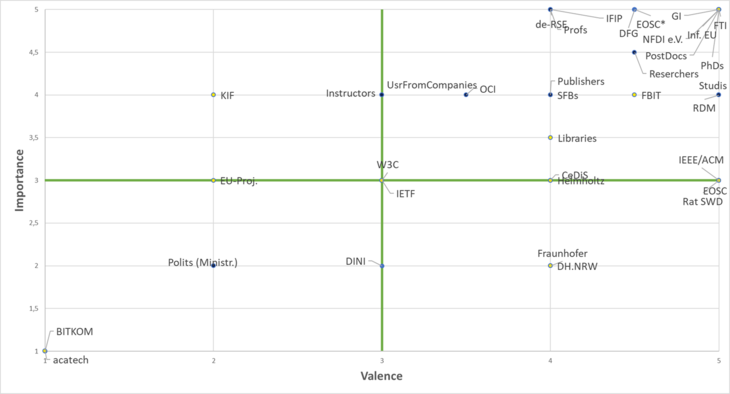
Stakeholder Map
Based on participants’ assessments, a stakeholder map was developed to visualize and prioritize key stakeholders. The map evaluates stakeholders along two axes: valence (positive or negative influence) and importance to project success. Stakeholders were rated on a scale from 1 (low) to 5 (high), providing a strategic overview of engagement priorities.
Meeting the Stakeholder Requirements
The stakeholder requirements are being addressed through two streams: system designand the community development. Together, these streams of analysis provide the foundation for extracting use cases and user stories that inform system architecture, the development the knowledge graph, and the identification of ethical and privacy considerations. They also shape the design of targeted community development activities.
To support this process, a functional personas methodology has been employed to capture stakeholder perspectives and guide engagement strategies.
A detailed analysis of requirements, persona development, and stakeholder engagement strategies will be presented in an upcoming series of community development blog posts. These posts will explore the action plan across three core dimensions: Building the community, Empowering its members, and Assuring the quality and sustainability of its development activities.