
No Data without Software: Panel discussion at Berlin Science Week
Open, high-quality research data and the development of robust research software go hand in hand when it comes to producing reliable insights and strengthening the scientific field—this was the unanimous view of the panelists. But what exactly is needed to achieve this?
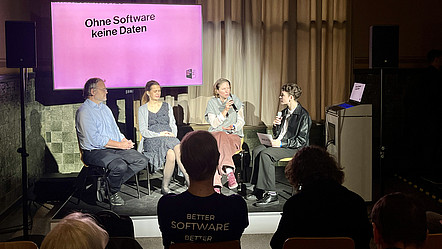
Moderator Maria Chlastak (GI) explored this question with Prof. Dr. Sonja Schimmler (Fraunhofer FOKUS), Carina Haupt (DLR e.V.), and Prof.Dr. Michael Goedicke (University of Duisburg-Essen) during Berlin Science Week.
On November 1st and 2nd, science enthusiasts of all ages and disciplines gathered at the Berlin Science Week Festival Hub—CAMPUS—in the Museum für Naturkunde in Berlin. The GI project teams from NFDIxCS and QUADRIGA seized the opportunity to engage with attendees amidst the towering dinosaur skeletons and ancient minerals, discussing topics from data competencies and research data and research software management to trends and foundations in computer science.
A highlight of the event was the panel discussion titled "No Data Without Software." High-quality research requires not only robust data but also suitable research software to generate, analyze, and present that data in a clear and accessible way. Maria Chlastak, policy and science officer at GI and a project team member at NFDIxCS and QUADRIGA, led a discussion with panelists and the audience on the relationship between FAIR data principles (findable, accessible, interoperable, reusable) and research software. They also explored the role of open versus commercial research software and how computer science can contribute to building a strong research software community in collaboration with other disciplines.
Good Infrastructure and Specific Research Software for FAIR Data
Research software fundamentally aims to ensure data availability and readability, explained Carina Haupt, head of the Sustainable Software Engineering group at DLR e.V., in her opening remarks. Depending on the discipline and application, very specialized software is often developed. At the same time, research software also forms the foundation for broader infrastructures like repositories and metadata platforms, added Prof. Dr. Sonja Schimmler, head of a research group at Fraunhofer FOKUS and spokesperson for NFDI4DS. She emphasized that FAIR data relies on solid infrastructures as well as specific software methods. Furthermore, advancements in AI can help improve data management and software quality, thus supporting FAIR data. However, the development of correct software also depends on good, FAIR data to prevent faulty software from producing incorrect results—a mutually reinforcing cycle.
Open Research Software Requires New Standards, Greater Recognition, and a Strong Community
Another major topic of discussion was the creation of new standards, as there are currently no universally accepted metadata standards for managing software as data. The panelists agreed that the development of new standards should take existing standards into account as much as possible and involve the entire community. Since standardization involves more human and social considerations than technical ones, the role of communities is crucial, explained Prof. Dr. Michael Goedicke, professor of practical computer science and software systems specification and spokesperson for NFDIxCS.
Research software and data communities are ultimately the groups that can adopt and establish new practices and standards. This requires fundamentally more recognition and incentives—not just for individual research but for open, reproducible research that other scientists can build on. Currently, publishing research software does little to enhance the reputation of research outcomes in established publication indices, so the push for open research and research software often occurs on a volunteer basis alongside “official” research activities, Prof. Goedicke explains. This is also why proprietary software is more common than open-source alternatives: to ensure the long-term availability of freely accessible research software, there needs to be broad user interest and voluntary community involvement and/or sustainable funding, said Prof. Goedicke.
Reflecting on the national research software community, Carina Haupt noted that it is still in the early stages but is welcoming new members to strengthen the “Better Software – Better Research” mission. A positive development, according to Prof. Schimmler, is that the research data community is increasingly engaging with research software. Each NFDI consortium now deals with research software, and although the foundations stem from computer science, interdisciplinary teams across all research fields are developing specialized software, she explained. The next step is to connect relevant working groups and expertise across consortia and to make the results more widely known within scientific institutions. Prof. Schimmler also highlighted the need for long-term employment prospects so that software development is no longer just a secondary aspect of research activities.
More Knowledge for Society Through FAIR Software and Data
The discussion expanded to consider the broader community with an audience question on how FAIR research software and data could benefit all citizens. The panel responded by emphasizing that only accessible and understandable data and correct research software can produce high-quality results that are relevant to society at large—a lesson underscored by the COVID pandemic. At the same time, all citizens are encouraged to contribute to the development and use of research software through citizen science initiatives, advancing scientific knowledge, concluded Prof. Goedicke.
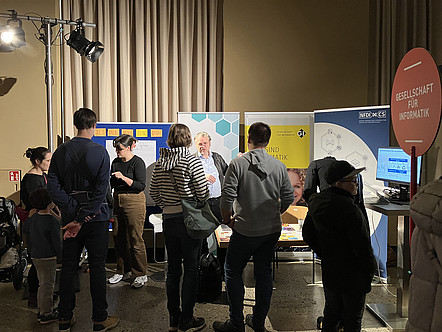
Before and after the discussion, project teams engaged with attendees at the exhibitor booth. Alongside NFDIxCS and QUADRIGA, other organizations like NFDI4DS and the DKZ.2R data competence center were present, highlighting the diverse range of offerings related to data competencies and research data. They discussed the challenges and solutions in data management—a vital step for science and for all those who wish to spread knowledge.
The recording of the panel discussion is available here (in German): https://youtu.be/dwk50mTiXbw