
NFDIxCS at the third NFDI Berlin-Brandenburg network meeting
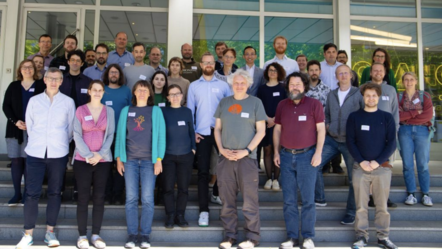
On May 21, 2025, the third NFDI Berlin-Brandenburg network meeting took place at the Weizenbaum Institute for the Networked Society (German Internet Institute) in Berlin. The event brought together approximately 40 participants from a range of NFDI consortia, including representatives from NFDIxCS.
Held under the overarching theme “Artificial Intelligence as an Enabler for Science”, the one-day event focused on how AI methods and Knowledge Graphs are increasingly transforming scientific research and research data management.
The day opened with a keynote that highlighted the role of Wikimedia‘s Knowledge Graph in the era of generative AI, underscoring the growing importance of structured, machine-actionable knowledge for enabling AI-supported research.
There were a number of interesting demonstrations in the morning session: NOMAD showcased the federated ecosystem for AI-ready data. NFDI4Cat presented its approach to automating catalysis research, highlighting “close the loop” in the research cycle. The third demo illustrated automated workflows and machine learning used for materials science simulations.
In the afternoon, participants explored further applications of AI in research. A compelling talk introduced scientific competitions that focused on AI-driven scholarly document processing. The MaRDI consortium demonstrated expanding access to the MaRDI knowledge Graph with a chatbot interface. A presentation on multi-modal language models addressed their potential in tackling sustainability challenges. Finally, NFDI4DS gave an overview of their services, in particular on their Gateway and Portal.
The meeting concluded with an insightful discussion session that identified two key dimensions of AI integration into the research process: (i) AI as a tool within scientific workflows, particularly for efficient data acquisition and management. (ii) the deployment of Large Language Models and chatbots, especially those based on Retrieval Augmented Generation, to enable new forms of interaction with scientific knowledge.
The event wrapped up with productive exchanges on future steps toward greater automation, interoperability, and the development of machine-actionable infrastructures to accelerate scientific discovery across disciplines.