
Focus on research data at the Nights of open Knowledge
Making data FAIR is one of the main concerns of all NFDI consortia. But what does this mean and what benefits does FAIR research data have for science? Maria Chlastak shed light on these questions in an interactive lecture at the Nights of open Knowledge in Lübeck.
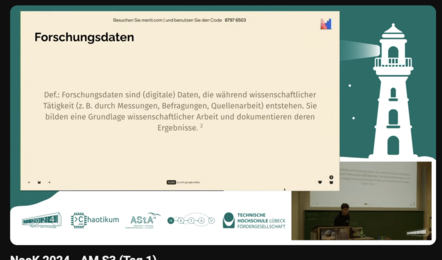
On November 8 and 9, the Nights of open Knowledge brought together mainly the owls among scientists from various disciplines in the Audimax of the University of Lübeck. The special feature of the conference: the program only starts in the evening and continues through the night. The knowledge sharing therefore takes place in a relaxed atmosphere over mate and beer rather than conference cookies and sparkling water. With the second talk of the first evening, Maria Chlastak, policy & science officer from NFDIxCS and the GI, welcomed the participants on site and in the live stream to the session “Research data in focus - with FAIR data to open science?”.
When we talk about the importance of open science, one crucial challenge we need to address is the so called replication crisis, began Maria the presentation. The replication crisis describes the fact that many research studies cannot be replicated due to inaccessible research data. This causes a serious loss of confidence in science, as errors and biases are not made apparent.
Therefore, a growing number of research data management initiatives, such as the NFDI, are aiming to make research data, i.e. data generated as a result of scientific activities, FAIR.
However, if we look at the meaning of FAIR (findable, accessible, interoperable, reusable), one aspect is not explicitly included: open. While there are many definitions for openness in relation to data, open data formats are in any case an essential prerequisite for linkable, interoperable data.
Only with FAIR data, we don’t achieve the goal of open science. At the same time, “of what use is open science if the data is not FAIR?", stated Maria. “We need both: FAIR and open data”.
To archieve this goal, we could appeal to scientists and companies to make their data openly available which is so far FAIR, but closed. In addition, computer science must provide the right infrastructure: for instance, better open research software is needed to make research appealing. In this regard, we should pay more attention to and support research software engineering, which is becoming increasingly professionalized alongside research data management.
There were several interesting questions from the audience regarding NFDI activities, research software engineering and how to deal with closed data. It will take both commitment and a cultural change to ensure that FAIR and open data become the standard in science.
The German-language record of the session is available as part of the stream: https://www.youtube.com/watch?v=RsHa5DS7pB8 (1:08:30)